

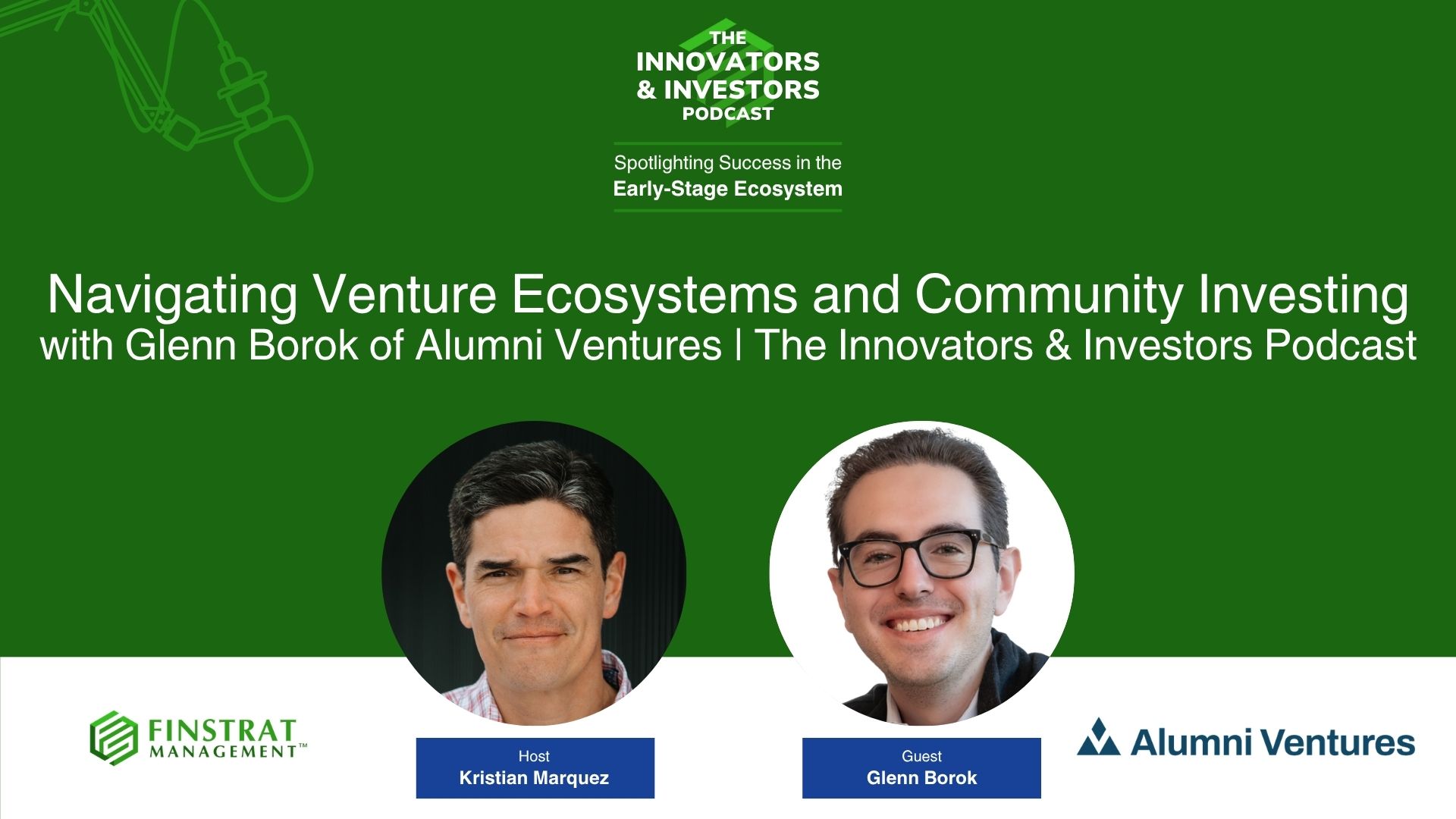
Navigating Venture Ecosystems and Community Investing with Glenn Borok of Alumni Ventures | The Innovators & Investors Podcast
June 23, 2026 | 41 MIN
Highlights
- Professional Background: Glenn’s transition from product strategy at LinkedIn to founding a Fintech startup and eventually moving into venture capital.
- The Alumni Ventures Model: How the firm utilizes university ecosystems to provide broader investor access to the venture asset class.
- Geography vs. Innovation: A deep dive into the unique “energy” of Silicon Valley compared to other emerging tech hubs like Austin and Miami.
- The “Moats” of AI: Analyzing what makes an AI-driven company defensible in a rapidly evolving market.
Summary
In this episode, Kristian Marquez sits down with Glenn Borok, a Principal at Alumni Ventures, to explore the mechanics of seed-stage investing and the shifting landscape of professional networking. Glenn shares his trajectory from LinkedIn’s Sales Navigator team to the front lines of venture capital, providing a grounded perspective on what it takes to build and fund companies in a high-velocity environment.
The conversation centers on the “platform shift” currently being driven by artificial intelligence. Glenn explains why Alumni Ventures decided to lean heavily into the seed stage, citing the need for early exposure to the best-in-class companies that are now raising more capital upfront than ever before. He discusses the firm’s unique community-based investing model, which leverages a vast network of over 15,000 LPs to support founders across diverse sectors.
A significant portion of the discussion is dedicated to the “Silicon Valley vs. Everyone” debate. Having lived in Chicago and Boston, Glenn offers a nuanced view of why the Bay Area remains the epicenter of the AI wave. He attributes this not just to capital, but to a specific “sense of spontaneity” and a concentrated ecosystem of talent from companies like OpenAI and Anthropic that is difficult to replicate elsewhere.
Finally, the episode tackles the challenge of defensibility in a world where “intelligence is becoming ubiquitous.” Glenn outlines the four pillars he looks for in a sustainable AI business: proprietary data, deep workflow integration, distribution advantages, and brand trust. This provides a blueprint for founders trying to build a lasting “moat” in an era of rapid technological disruption.
Key Takeaways
- The Human Factor: At the pre-seed and seed stages, investment decisions are primarily bets on the resilience and “salesmanship” of the founding team.
- Workflow Integration as a Moat: Defensibility in AI comes from being deeply embedded in a user’s daily tools, rather than just offering a standalone “feature”.
- The Value of Alumni Networks: Leveraging specific professional and university ecosystems (like LinkedIn or Ivy League networks) remains one of the most effective methods for high-quality deal sourcing.
- “Taste” in Building: As technical barriers to building apps drop, the “taste” and “agency” of the builder—knowing what to build and why—become the primary differentiators.
Conclusion
This episode provides an essential look at the current state of early-stage investing through the lens of Glenn Borok and Alumni Ventures. By focusing on the intersection of community-driven capital and AI innovation, Glenn offers valuable perspectives for any entrepreneur or investor looking to understand the next decade of venture growth and the enduring importance of geographic hubs in a digital world.
Stay up-to-date with Glenn Borok and his work with Alumni Ventures.

Follow our show on your podcast channel of choice or listen below.