

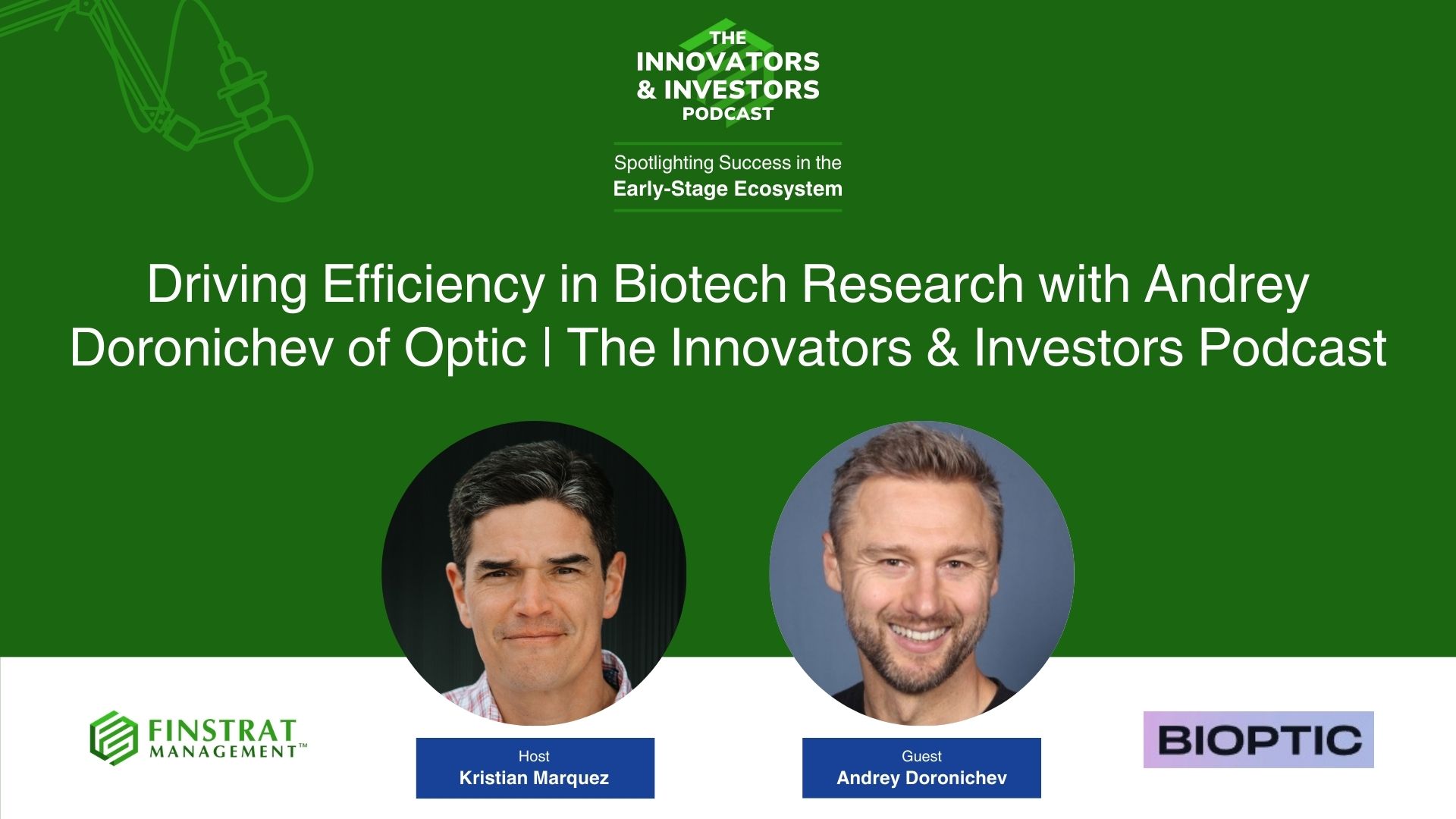
Driving Efficiency in Biotech Research with Andrey Doronichev of BIOPTIC | The Innovators & Investors Podcast
April 14, 2026 | 38 MIN
Highlights
- The Google Legacy: Andrey discusses managing the YouTube app from zero to one billion users and how machine learning powered that growth.
- The BIOPTIC Mission: An overview of how BIOPTIC acts as a “Junior Biotech Analyst” to automate competitive intelligence.
- The Power of Focus: Why even a giant like Google can fail (e.g., Stadia) when attention is spread too thin.
- The AI Noble Prize: Discussion of Google’s AlphaFold and its impact on predicting 3D protein structures.
- The Future of Pharma: A prediction that every pharmaceutical company must become “AI-native” within ten years or face obsolescence.
Summary
In this episode of The Innovators & Investors Podcast, Kristian Marquez sits down with Andrey Doronichev, a seasoned product leader whose career spanned 14 years at Google. Andrey shares the pivotal story of building the YouTube mobile application and reveals that its global success was less about video hosting and more about the invisible machine learning infrastructure that governed recommendations and content moderation.
Transitioning from consumer tech to Life Sciences, Andrey explains the “why” behind his latest venture, BIOPTIC. He addresses a critical gap in the market: while general AI like ChatGPT is useful for consumer tasks, the high-stakes world of drug development requires a level of scientific accuracy and “agentic scaffolding” that standard models cannot provide. BIOPTIC aims to solve this by providing researchers and investors with automated, scientifically accurate due diligence.
The conversation dives deep into the philosophy of “Focus vs. Scale.” Andrey candidly discusses his time leading the Stadia project at Google, noting that even with unlimited resources, a lack of institutional focus can lead to failure. He applies these lessons to the lean, high-velocity world of biotech startups, where the ability to automate thousands of workflows—from DNA sequencing analysis to clinical trial protocols—is a competitive necessity.
Finally, the episode explores the technical hurdles of AI in medicine, specifically the “data gold mine” required to train effective models. Using the Protein Data Bank (PDB) as an example, Andrey illustrates how curated, high-quality data enabled Google’s AlphaFold to win a Nobel Prize in Chemistry, and how BIOPTIC is now helping to curate similar datasets for the next generation of drug discovery.
Key Lessons
- Infrastructure Over Interface: In the AI era, the underlying machine learning “engine” is more vital for retention than the user interface itself.
- The “Agentic” Shift: Moving beyond simple LLMs to “Agentic Scaffolding” allows AI to perform complex, multi-step research tasks like a human analyst.
- Focus is a Resource: Small startups can out-compete giants by maintaining a singular focus that large organizations often lack.
- Data Curation as a Moat: Scientific AI is only as good as the curated data it consumes; manual moderation of data remains a critical foundation for automated success.
Conclusion
This episode provides an essential look into the intersection of high-level software engineering and the future of medicine. Andrey Doronichev leverages his experience at Google to demonstrate how BIOPTIC is driving innovation in the biopharma space. For those interested in investment strategies and entrepreneurship, this discussion highlights why becoming AI-native is no longer optional for modern enterprises.
Stay up-to-date with Andrey Doronichev and his work with BIOPTIC.

Follow our show on your podcast channel of choice or listen below.