

Ending Interview Theatre and Finding True Professional Fit
June 23, 2026 | 34 MIN
In the corporate landscape of mid-2026, a strange paradox has taken hold. Rolling layoffs across elite technology firms have flooded the market with highly qualified applicants. Yet, early-stage growth companies and small businesses report that finding the right talent has never been more volatile.
According to venture capital data, poor hiring management and team friction now rank as the third-leading cause of startup mortality, sitting uncomfortably ahead of cash depletion. The root cause, experts say, is a structural failure in how human capital is evaluated.
“Resumes and interviews are now theater,” says Kingshuk Khan, founder and chief executive of Ikigai, an early-stage human resources technology startup. “We are flattening people to a literal page, which means companies aren’t hiring people who are good at the job—they are hiring people who are good at interviewing about the job.”
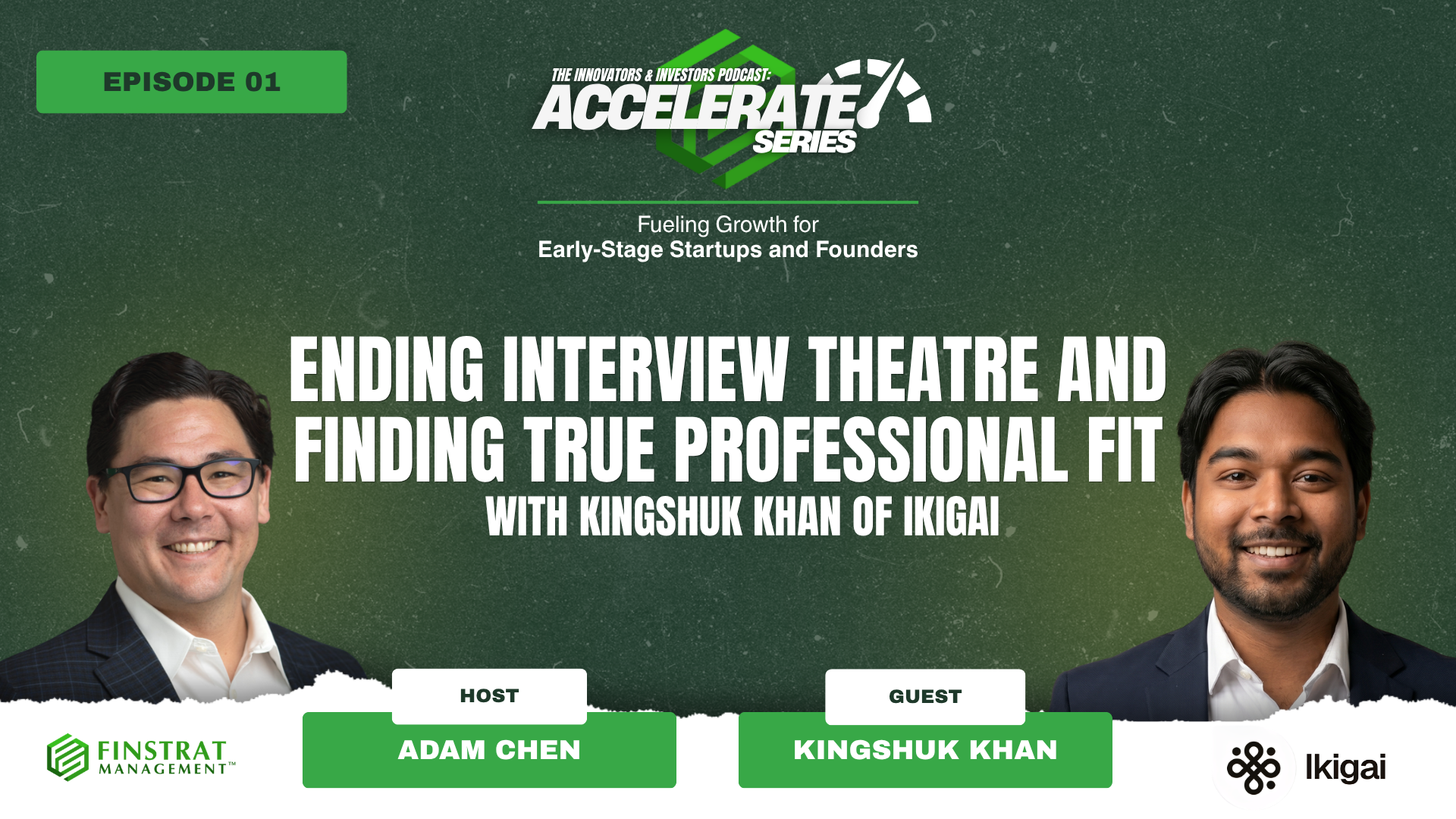
Mr. Khan, a veteran software engineer with stints at Alphabet Inc.’s Google and International Business Machines Corp., discussed the friction underlying modern corporate recruitment on the latest episode of the Innovators and Investors Podcast: Accelerate Series with host Adam Chen.
The Cost of the ‘Mishire’
For early-stage companies, where headcount is lean and every individual exerts a disproportionate cultural pull, a single hiring mistake can dismantle months of operational momentum. Mr. Khan notes that traditional screening mechanisms rely heavily on pattern matching—cloning the background traits of employees at massive tech incumbents—which rarely translates to the ambiguous, execution-heavy environment of a nascent startup.
To solve this, Ikigai has constructed a predictive behavioral platform that sits between the legacy Applicant Tracking System (ATS) and the final interview loop. Rather than scanning for keywords, the platform targets psychological triggers, behavioral history, and qualitative alignment to build deep individual profiles.
The software’s predictive accuracy was recently illustrated in a corporate case study involving a candidate who appeared flawless on paper but ultimately failed to execute under startup conditions. When Ikigai retroactively processed the candidate’s pre-hire data through its updated core engine, the system flagged 16 distinct failure modes—all of which precisely manifested during the candidate’s brief tenure.
“The machine flagged that if you asked him to do cold calls or anything meticulous, he would collapse,” Mr. Khan said. “Sure enough, the disengagement happened almost immediately.”
The Proximity Multiplier
The financial arguments for precision hiring extend beyond avoiding a bad actor; they directly influence collective output. Mr. Khan cited organizational psychology metrics illustrating the “proximity effect” within modern workspaces. Proximity to a low-performing employee can degrade an individual’s localized productivity by 15% to 20%, whereas integration with a high performer can yield a 30% surge in output.
While contemporary enterprise focuses intensely on leveraging artificial intelligence for raw productivity gains, Mr. Khan argues that structural breakthroughs are inherently tied to human motivation. True corporate leverage comes when teams achieve a shared “flow state,” driven by what he calls human “euphoria moments”—spontaneous flashes of collaborative insight that software logic cannot replicate.
“Humans are still the unique ones here,” Mr. Khan said. “I have looked at the data closely, seen what is happening under these large language models, and seen where the limits are. We might not ever be able to beat human connection with AI.”
For founders navigating an uncertain macroeconomic climate, Mr. Khan’s ultimate prescription relies on a blend of data-driven filtering and fundamental intuition. “Trust your gut,” he said. “If something feels a little off, if something is not focused, cut it and go back to work.”
Stay up-to-date with Kingshuk Khan and his work with Ikigai.

Follow our show on your podcast channel of choice or listen below.