

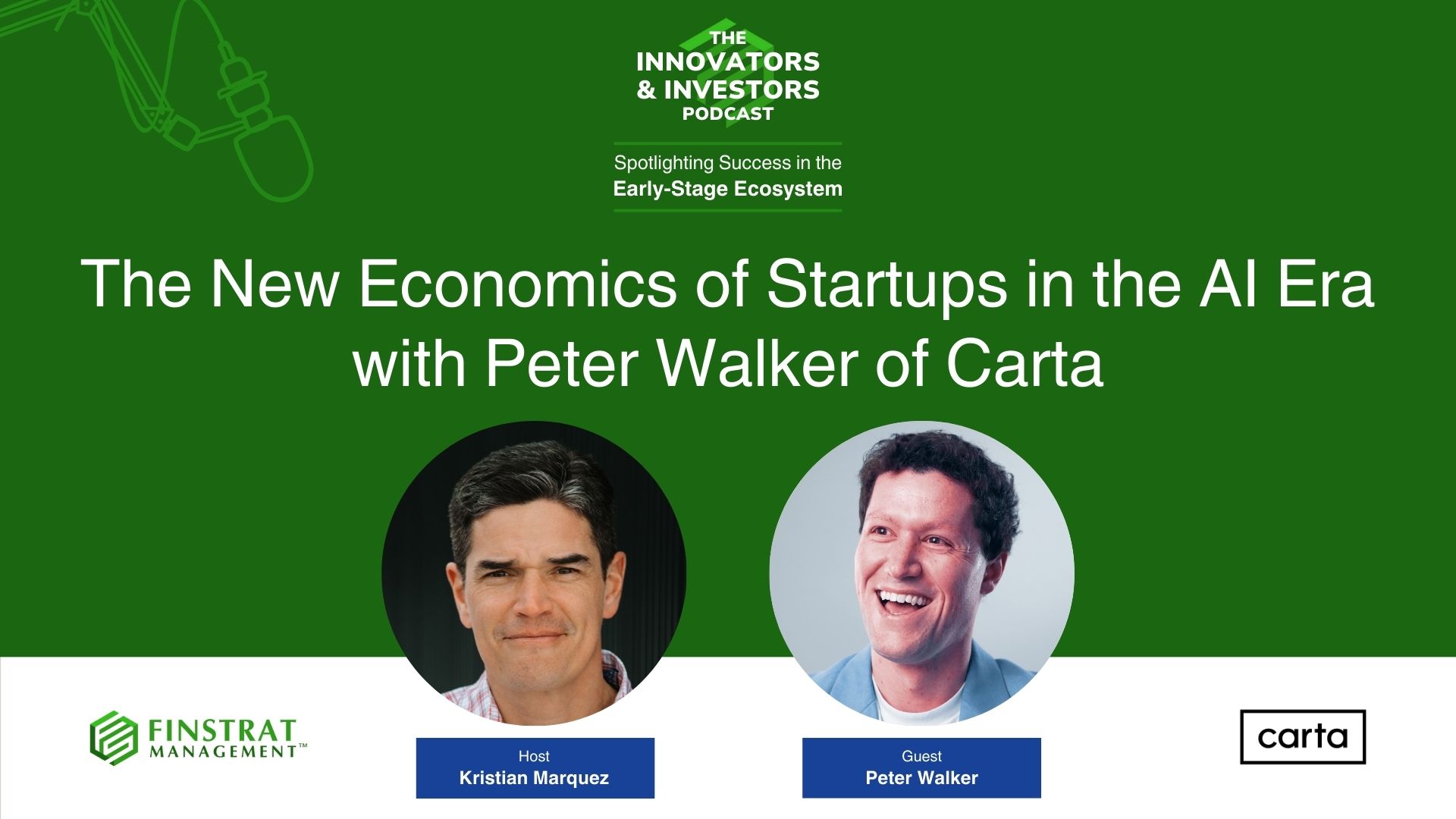
The New Economics of Startups in the AI Era with Peter Walker of Carta
January 27, 2026 | 45 MIN
Highlights
- AI is dramatically reshaping startup growth, fundraising, and hiring benchmarks in the venture ecosystem.
- Seed and Series A valuations have surged beyond 2021 peaks but are increasingly supported by real revenues.
- Silicon Valley remains the epicenter of high valuations and unicorn creation, despite growing venture activity in other U.S. cities.
- Venture capital is bifurcating into mega funds with multi-stage capabilities and emerging managers focusing on early-stage, smaller funds, including solo GPs.
- LPs demand greater valuation consistency and realism from GPs, increasing scrutiny on portfolio reporting.
- Secondary markets for venture stakes are growing, especially around well-known late-stage private companies.
- AI is causing startups to delay or reduce hiring, leading to leaner teams but potentially more productive workforces.
Summary
In this episode of the Innovators and Investors Podcast, host Kristian Marquez interviews Peter Walker, Head of Insights at Carta, about the evolving venture capital (VC) and startup ecosystem, with a focus on data-driven insights derived from Carta’s unique position in the market. Peter explains how Carta manages cap table data for over 60,000 startups and nearly 3,000 venture funds, allowing his role to blend data storytelling, research, and market analysis to provide valuable benchmarks for founders, investors, and other ecosystem participants.
They discuss the impact of artificial intelligence (AI) on startup growth, hiring, and capital raising. AI is driving unprecedented revenue growth in AI-native startups, raising the bar for what is considered “great” growth and reshaping fundraising dynamics. However, AI also leads to leaner teams, as companies delay or reduce hiring by leveraging AI tools, shifting benchmarks such as revenue per employee.
Valuations at seed and Series A rounds have risen significantly, often exceeding pre-pandemic peaks, but many startups now have real revenues backing these valuations, differentiating the current environment from prior “bubble” periods. Geographic disparities persist, with Silicon Valley maintaining dominance in unicorn creation and high valuations, though venture activity is becoming more distributed across U.S. cities. The Bay Area is currently experiencing a revitalization, fueled in part by the AI boom.
On the venture fund side, Peter highlights a bifurcation between mega funds and emerging managers. Mega funds continue to raise significant capital by offering multi-stage investment capabilities and exposure to highly valued late-stage private companies, while smaller funds face more fundraising challenges and often focus on narrower or earlier-stage strategies. A rising trend among emerging managers is the prevalence of solo GPs and funds maintaining consistent, smaller fund sizes to specialize in early-stage investing.
The relationship between general partners (GPs) and limited partners (LPs) is evolving, with LPs increasingly scrutinizing valuation consistency across funds and the realism of GPs’ portfolio valuations. Secondary market activity is growing, particularly around well-known unicorn companies, reflecting a maturing venture ecosystem.
Peter shares his personal background, how he came to lead insights at Carta, and his current focus on understanding AI’s effects on hiring in startups. He observes significant reductions in headcount at Series A companies over recent years, likely due to AI delaying hiring rather than outright job losses. Both Peter and Christian emphasize the importance of viewing AI as a productivity tool that may slow hiring growth but also enable companies to scale more efficiently.
Looking ahead, Peter anticipates more secondary market activity, potential democratization of private market investing (e.g., through 401(k) access), and ongoing challenges in balancing optimism and realism in venture valuations. He encourages founders and investors to stay informed and adaptable in this rapidly changing environment.
Key Insights
- AI Redefines Growth and Hiring Paradigms: AI-native startups are achieving growth rates previously unimaginable (e.g., Cursor’s ARR growth from $1M to $1B in two years), resetting what investors expect from companies. This raises the bar for founders, who must now view historically “great” growth as merely “good.” Additionally, AI enables startups to operate with leaner teams, delaying or reducing hiring. This shift challenges traditional benchmarks, such as valuing team size as a measure of success, replacing it with metrics like revenue per employee. The broader implication is a more capital-efficient but potentially less labor-intensive startup ecosystem.
- Valuations Are High but More Grounded Than Before: Seed and Series A valuations have increased materially, with Carta’s median seed pre-money valuation now around $16–$17 million, exceeding previous peaks. However, unlike the 2021 bubble, these valuations are often accompanied by real revenue generation, lending more credibility and stability to current prices. This duality means while some AI and buzzy startups may be overvalued, many early-stage companies have solid fundamentals, making the current market a nuanced landscape rather than a uniform bubble.
- Silicon Valley’s Enduring Dominance Despite Geographic Dispersion: Although early-stage venture capital activity is more geographically distributed across the U.S., Silicon Valley remains the leading hub for high valuations, unicorn creation, and late-stage funding. The Bay Area’s ecosystem benefits from dense talent pools, capital access, and a vibrant entrepreneurial culture, which AI’s resurgence has recently revitalized. Founders aiming for maximum valuation upside often find relocating to Silicon Valley advantageous, though successful startups can and do emerge elsewhere. This concentration underscores structural advantages that are difficult to replicate.
- Venture Capital Splitting into Two Distinct Markets: The venture industry is effectively bifurcating into mega funds and emerging managers. Mega funds (e.g., Andreessen Horowitz, Sequoia) raise multi-billion-dollar funds, offering LPs access to high-profile private late-stage companies and the ability to lead multiple rounds in a single company. These funds have an easier time raising capital despite longer liquidity cycles. Conversely, smaller emerging managers face tougher fundraising conditions but differentiate themselves by focusing on niche strategies, maintaining consistent fund sizes, or operating as solo GPs. This split suggests very different risk-return profiles and operational approaches within venture capital today.
- LPs Demand Transparency and Realism in Valuations: LPs increasingly face challenges reconciling varying valuations for the same portfolio companies across different funds, which complicates performance assessment and trust. They favor conservative valuations and are wary of overly optimistic projections common in frothy markets. This dynamic pressures GPs to balance optimism with sober, responsible valuation practices and suggests an opportunity for tools—like Carta’s valuation products—to provide more standardized, data-driven guidance, although no single “right” valuation exists.
- Secondary Markets Are Growing But Remain Concentrated: Secondary sales of venture fund stakes and portfolio company shares are becoming more common as liquidity pressures mount, particularly for well-known unicorns like SpaceX. However, secondaries in earlier-stage companies remain limited due to the illiquid and risky nature of these assets. As companies stay private longer, pressures to provide liquidity to early investors and employees will drive growth in secondary transactions, ultimately contributing to a more mature and flexible venture ecosystem.
- AI’s Impact on Startup Employment Is More About Delay Than Elimination: Data shows a significant reduction in employee counts at Series A startups over recent years (from median 25 employees in 2021 to 14 projected in 2025), likely driven by AI tools enabling delayed hiring rather than outright job losses. Founders and CEOs view AI more as an augmentation tool that improves productivity and reduces upfront headcount needs but still requires human oversight and quality assurance. This suggests future workforce dynamics will emphasize efficiency and tech augmentation rather than wholesale displacement.
Conclusion
Peter Walker’s insights reveal a venture ecosystem in flux, driven by technological innovation, evolving capital dynamics, and shifting market expectations. AI is a transformative force reshaping startup growth, team structures, and fundraising benchmarks. Venture capital itself is splitting into distinct arenas of mega funds and specialized emerging managers, while LPs demand greater transparency and realism. Secondary markets are expanding, and geographic diversification of venture activity is increasing, though Silicon Valley remains dominant. These trends underscore the need for data-driven understanding and adaptability for founders, investors, and ecosystem participants navigating this complex landscape.
Stay up-to-date with Peter and his work with Carta.

Follow our show on your podcast channel of choice or listen below.