

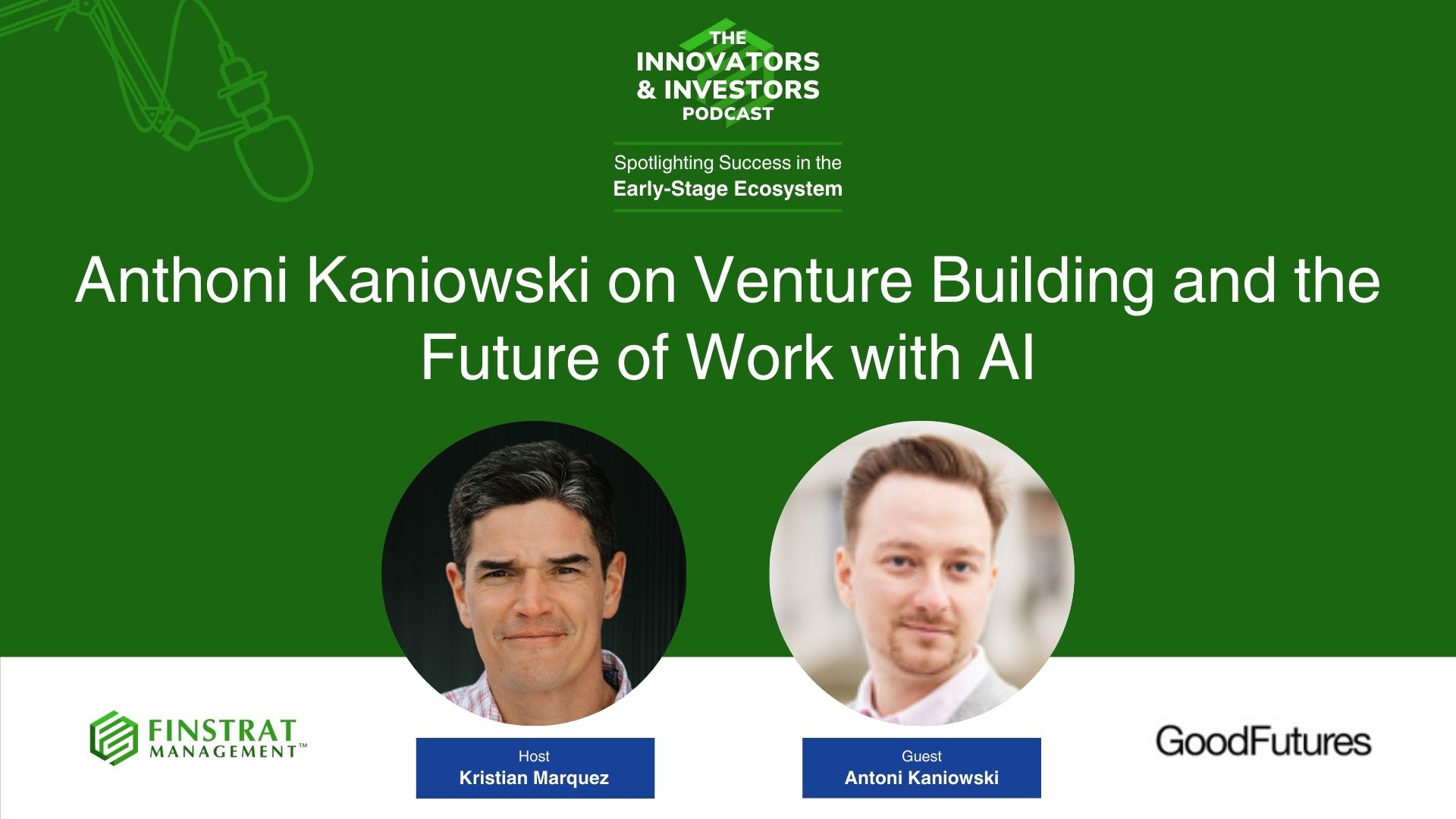
Antoni Kaniowski on Venture Building and the Future of Work with AI
December 16, 2025 | 36 MIN
Highlights
- Good Futures is a CMU-affiliated venture builder focused on AI’s impact on the future of work.
- The company targets early-career founders with product talent, providing vital mentorship on business fundamentals.
- 🇺🇸 The U.S. market offers a uniquely open and efficient environment for B2B SaaS startups compared to Europe.
- Venture building leverages shared resources to increase startup success rates and accelerate validation.
- AI-native companies are reshaping SaaS with different architectures, focusing on vertical markets and new value propositions.
- Trust and distribution are critical in B2B service adoption, balancing automation with human relationships.
- In B2B, delivering outcomes matters more than the product itself—success is about solving customer problems efficiently.
Summary
In this episode of The Innovators and Investors Podcast, Kristian Marquez interviews Antoni Kaniowski, COO of Good Futures, a Carnegie Mellon University-affiliated venture builder focused on the future of work, workforce, and AI. Good Futures builds new companies that address the evolving landscape of employment shaped by artificial intelligence, particularly filling gaps in the traditional hire-train-deploy corporate strategy that AI now disrupts. Antoni shares his journey from technical roles to business-building across Europe and Poland, applying his experience to streamline operations and validate startups quickly and efficiently.
Venture building, according to Antoni, is about producing companies repeatedly with higher success rates by leveraging shared knowledge, resources, and back-office support. Good Futures sources founders primarily from Carnegie Mellon University, targeting early-career individuals with product-building talent who require mentorship to focus on business fundamentals, particularly understanding the core transaction their company facilitates.
Antoni highlights the unique advantages of the U.S. market for B2B SaaS startups, emphasizing ease of business development, openness to risk-taking, and a high-trust environment compared to the more relationship-driven and slower European markets. The company’s capital structure is currently a hybrid: some internal capital is deployed to start operations, but Good Futures seeks external investors to support its long-term vision as a holding company building multiple ventures over three to five years.
On operational involvement, Antoni explains that the degree to which Good Futures intervenes in startups varies, depending on the founder’s experience and character. The goal is to balance hands-on guidance with enabling founders to take ownership and run their companies effectively. He stresses the importance of swift decision-making and knowing when to stop perfecting a product and move forward—a mindset borrowed from private equity operational playbooks.
Antoni also discusses the impact of AI on SaaS valuations and business models, noting that AI-native companies are being built with fundamentally different architectures and value propositions, often focused on vertical markets. Good Futures’ investment thesis revolves around addressing new market tensions introduced by AI, such as challenges in recruitment where AI amplifies candidate volume but decreases fit quality due to over-optimization of profiles.
The conversation touches on the risks of rapid technological change and how Good Futures mitigates them by focusing on the intersection of distribution and trust—key factors for B2B customers deciding between automated and human-assisted services. Antoni’s background includes consulting and startup turnarounds, providing a solid foundation for venture building. One of his biggest lessons is that in B2B markets, the product itself is secondary to delivering the promised transaction or outcome; success is measured by the resolution of customer problems rather than product features.
Finally, the discussion concludes with reflections on aligning expectations between founders and investors, particularly regarding fund horizons and returns. Antoni encourages founders to engage openly with investors to ensure mutual understanding, especially as Good Futures navigates building multiple companies with a long-term perspective.
Key Insights
- Venture Building as Operational Efficiency: Venture building is not just about funding startups but systematizing company creation with shared knowledge and resources to improve success rates. This approach highlights the importance of operational rigor and rapid validation, cutting unnecessary activities to focus on transaction essence. It contrasts with traditional startup creation by emphasizing repeatability and scale.
- Talent Sourcing from Academia: Good Futures’ link to Carnegie Mellon University provides a pipeline of young founders who already possess technical and product-building skills but require coaching in commercial and transactional thinking. This underscores the value of institutional partnerships in venture ecosystems, where academic networks can feed innovation engines.
- Market Entry Strategy – U.S. vs Europe: Antoni’s experience reveals that the U.S. market’s openness and speed make it a favorable testbed for B2B SaaS startups, even for companies based abroad. The U.S. environment allows faster connections with early adopters willing to experiment, while European markets tend to have slower, relationship-heavy sales cycles. This insight is critical for startups considering geographic focus early on.
- Capital Structure Complexity in Venture Building: The discussion on capital raises highlights challenges in fitting venture builders into traditional VC or PE investment models. Good Futures leans towards a holding company model with a longer horizon and sweat equity, which can be less attractive to typical VCs but may appeal to investors aligned with patient capital and operational involvement.
- Balancing Founder Autonomy and Studio Involvement: The degree of hands-on involvement Good Futures maintains with founders depends on the founder’s maturity and capability. This dynamic balancing act is crucial in venture building—too much control stifles founder initiative; too little risks misalignment. The approach emphasizes adaptive leadership tailored to individual founder needs.
- AI’s Disruptive Role in SaaS Valuations and Models: The AI wave is driving down valuations of traditional SaaS companies by introducing competition with AI-native firms that use fundamentally different architectures and solve problems in more focused verticals. This insight suggests that future SaaS ventures must incorporate AI thoughtfully to remain competitive and relevant.
- Outcome-Oriented Mindset Over Product-Centricity: Perhaps the most profound insight is Antoni’s assertion that in B2B, the product is merely a vehicle to deliver the transaction or service outcome. Startups must shift from obsessing over product perfection to validating and delivering measurable business results. This mindset aligns closely with private equity thinking and challenges the conventional startup narrative of product-first success.
Conclusion
Antoni Kaniowski’s experience and Good Futures’ venture-building model offer a nuanced perspective on startup creation in the AI-driven future of work. By blending operational discipline, strategic talent sourcing, and a focus on transaction outcomes, Good Futures aims to efficiently build multiple successful ventures that address emerging gaps created by AI’s transformative impact. Their approach, informed by global market insights and a flexible capital model, exemplifies a modern, adaptive way to innovate and invest in the evolving B2B SaaS landscape.
Stay up-to-date with Antoni Kaniowski and his work with GoodFutures.

Follow our show on your podcast channel of choice or listen below.