

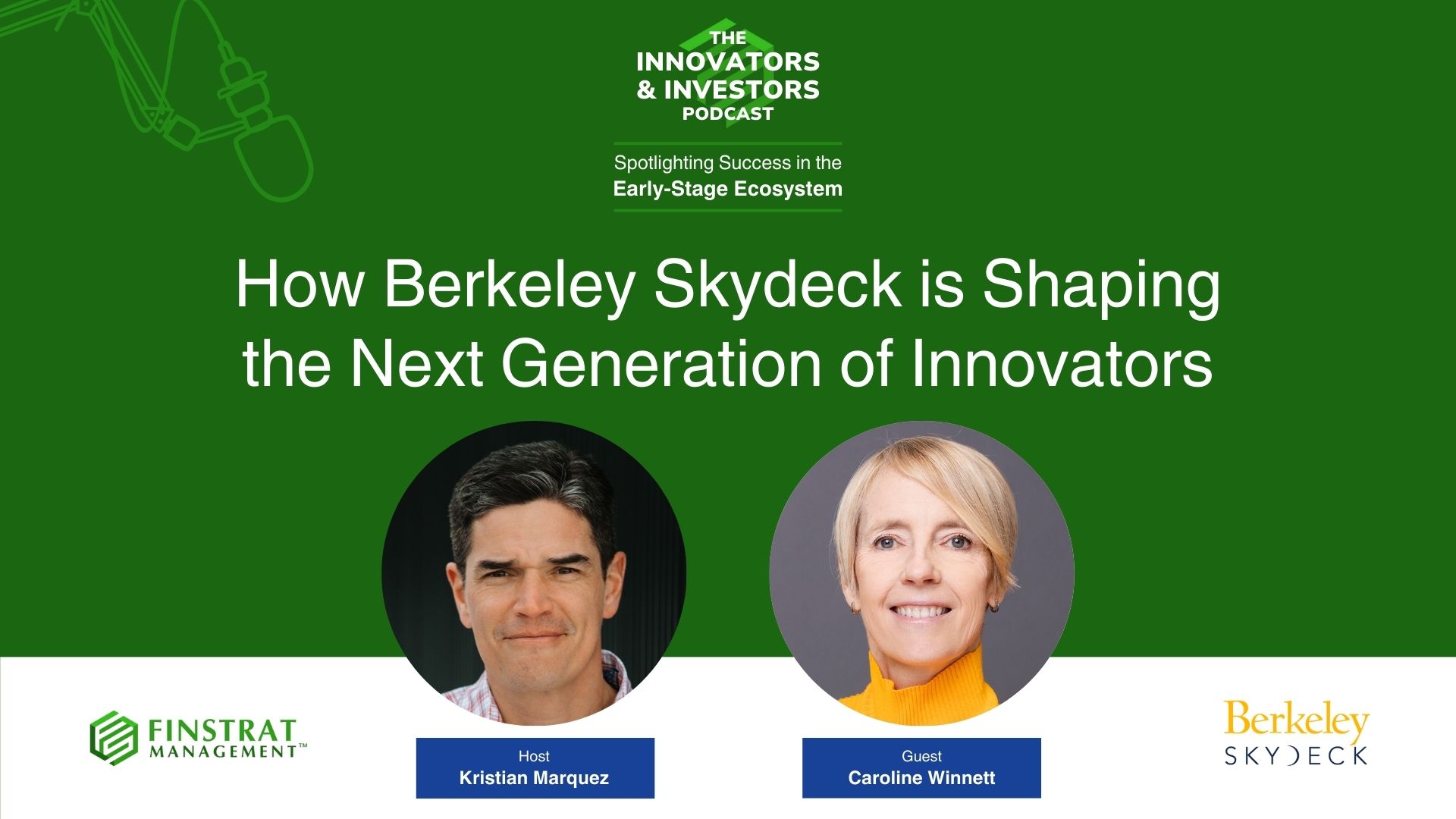
How Berkeley Skydeck is Shaping the Next Generations of Innovators
January 13, 2026 | 46 MIN
Highlights
- Berkeley Skydeck evolved from a small program into a top-tier accelerator under Caroline Winnett’s leadership.
- The Berkeley Skydeck Fund, a private venture fund, uniquely supports startups financially and benefits the university.
- The accelerator attracts thousands of global applicants, welcoming founders from any university worldwide.
- Selection involves hundreds of alumni advisors who carefully vet thousands of applications twice a year.
- Success metrics include follow-on funding, startup valuation, student engagement, and enhanced university reputation.
- Strong international partnerships, especially with Japan’s JETRO, expand Skydeck’s global impact.
- Caroline’s personal journey from musician to successful founder and accelerator director inspires diverse career paths.
Summary
On our latest episode of The Innovators & Investors Podcast, Caroline Winnett, Executive Director of Berkeley Skydeck, shares deep insights into the evolution and success of one of the leading university-affiliated startup accelerators in the United States. Skydeck, originally a modest program, transformed under her leadership into a powerhouse accelerator closely tied to a unique venture fund that financially supports startups and benefits UC Berkeley. The accelerator has grown exponentially in reputation and applicant volume, now attracting thousands of startups globally, not limited to Berkeley affiliates. The program’s success stems from a blend of strong university culture, strategic venture funding, and a robust network of alumni advisors and professional investors. Winnett emphasizes the importance of founder preparedness, customer-centric product development, and the accelerator’s role in helping early-stage startups turn ideas into investable businesses. She also highlights Berkeley’s unique position in Silicon Valley, the culture of entrepreneurship on campus, and the university’s role in fostering innovation, which other institutions increasingly seek to emulate. Additionally, she discusses the accelerator’s international partnerships, particularly with Japan’s JETRO, and shares personal reflections on her career and key lessons from her own startup experience. Overall, Skydeck exemplifies how a public university can successfully blend education, entrepreneurship, and venture capital to create a sustainable innovation ecosystem.
Key Insights
- Catching the Waves of Innovation: Winnett compares the growth of Skydeck to catching bigger waves with a surfboard, illustrating how strategic vision and timing can amplify a program’s impact. The accelerator’s growth from 55 applications in 2015 to 3,800 in recent years reflects a rising global interest in university-led innovation hubs. This surge is fueled by the unique funding model and the vast Berkeley alumni network, demonstrating the power of community-driven entrepreneurship ecosystems.
- Innovative Funding Model Bridges Public University and Venture Capital: Skydeck’s establishment of a private venture fund to invest in startups is groundbreaking for a public university. Unlike typical educational funding reliant on donations or endowments, this fund attracts professional investors expecting market returns, aligning financial incentives with Berkeley’s educational mission. This model not only sustains the program but also creates a new revenue stream for the university, representing a scalable approach for other research institutions.
- Founder Maturity and Preparedness Have Dramatically Improved: Over the past decade, the quality and sophistication of founders applying to Skydeck have significantly increased. Access to abundant online resources, accelerator programs, and startup knowledge has raised the baseline expectations for founders. This evolution underscores the democratization of entrepreneurship education and the increasing professionalism within the startup ecosystem.
- Human-Centric Selection Process Leveraging Alumni Expertise: Despite the volume of applications, Skydeck relies heavily on a dedicated network of approximately 900 volunteer advisors, mostly Berkeley alumni, who apply industry-specific expertise to evaluate startups. This human-driven evaluation fosters community engagement and ensures nuanced, sector-specific assessments that automated systems alone cannot replicate, highlighting the value of human judgment in early-stage investment decisions.
- University Culture and Location Are Critical Success Factors: Berkeley’s proactive cultural shift toward entrepreneurship—such as recognizing startup activity in faculty tenure evaluations—and its location in Silicon Valley provide a fertile environment for innovation. The presence of an ecosystem rich in talent, investors, and service providers is indispensable. This insight emphasizes that replicating Skydeck’s success requires more than just programs—it demands cultural and geographic advantages or strategic compensations.
- Global Impact Through Strategic International Partnerships: Skydeck’s collaboration with Japan’s JETRO exemplifies how university accelerators can extend influence beyond local borders. Japan’s focus on translating its world-class research talent into startups aligns well with Skydeck’s mission, showcasing how international governments and institutions can leverage accelerators to catalyze innovation ecosystems. This partnership model can be a blueprint for other universities seeking global engagement.
- Customer Obsession and Demonstrations Are Key Startup Lessons: Drawing from her own startup journey with Neurofocus, Caroline stresses the importance of obsessing over customer feedback and using their language to articulate problems and solutions. Moreover, delivering compelling demos that vividly showcase product value builds credibility and trust with investors and clients. These lessons remain vital for early-stage startups aiming to transform ideas into viable businesses.
- Educational and Talent Development Role of Accelerators: Beyond funding and company growth, Skydeck serves as a critical conduit for student involvement through internships and experiential learning. This symbiotic relationship benefits startups with fresh talent and students with real-world exposure, strengthening the university’s broader educational mission while reinforcing the accelerator’s ecosystem.
- Leadership and Culture Champions Drive Ecosystem Growth: The role of key individuals like Rich Lyons—former dean, current chancellor, and innovation champion—demonstrates how leadership commitment to culture change and ecosystem building is essential. Lyons’ influence transformed Berkeley’s startup environment from fragmented efforts into a cohesive community, highlighting the importance of visionary leadership in institutional innovation.
- Non-Traditional Career Paths Can Lead to Startup and Leadership Success: Caroline’s transition from a professional musician to a successful entrepreneur and executive director of a major accelerator illustrates that diverse backgrounds can provide unique strengths in business. Her story encourages aspiring founders and leaders from varied fields to embrace entrepreneurship, reinforcing that passion, adaptability, and continuous learning often outweigh linear experience.
- Measuring Success Beyond Financial Returns: While follow-on capital and fund performance are critical, Berkeley Skydeck also tracks metrics like student participation, internship placements, and the accelerator’s impact on university reputation. This multi-dimensional approach ensures alignment with Berkeley’s public education mission and fosters a sustainable innovation ecosystem that benefits multiple stakeholders.
- Ongoing Evolution and Adaptation Are Integral: Caroline notes that while the program could theoretically have moved faster, the organic growth and iterative learning process have led to a strong and stable foundation. This underscores the importance of patience and adaptability in building lasting institutions, especially in complex, multi-stakeholder environments like universities.
- Accessibility and Openness Enhance Program Reach: By opening Skydeck applications to founders from any university or background, with Berkeley startups given priority but not exclusivity, the program fosters diversity and inclusivity. This openness attracts top talent globally and enriches the ecosystem, illustrating that university accelerators can be both rooted locally and globally oriented.
- Engagement with Founders Builds Trust and Commitment: The fact that founders often relocate or turn down other opportunities to join Skydeck reflects the trust and value the accelerator delivers. This commitment from entrepreneurs is a testament to the program’s reputation and supportive environment, which is crucial for long-term success and alumni advocacy.
Conclusion
Berkeley Skydeck represents a pioneering model in university entrepreneurship, proving that with the right culture, leadership, funding innovation, and community engagement, a public university can become a formidable player in the startup world. Caroline Winnett’s experience offers valuable lessons on building sustainable accelerators, nurturing founder talent, and bridging academia with venture capital. Her story and Skydeck’s growth highlight the transformative power of entrepreneurship ecosystems rooted in education, collaboration, and innovation.
Stay up-to-date with Caroline Winnett and her work with Berkeley SkyDeck.

Follow our show on your podcast channel of choice or listen below.